10 Best Pizza Ovens for Home (October 2026)
The best pizza ovens for home include the Big Horn 12 inch multi-fuel for exploring outdoor fuels, the Ninja Artisan MO201 for flame-free patio cooking, and the Ooni Karu 2 for tending real fires.
On this page (6 sections)
The best pizza oven for home depends first on where you'll cook: choose Big Horn 12 inch multi-fuel for outdoor fuel flexibility, Piezano for a small kitchen counter, or Ninja Artisan MO201 for flame-free patio cooking.
Big Horn leads this roundup because you can start with pellets and add another fuel option later. That flexibility matters only if you'll use it; a dedicated electric or propane oven is a better fit for a fixed routine.
ChipperChimney compared fuel, cooking space, controls and included tools. Start with our comparison of gas, wood and electric pizza ovens for the main differences, or our best outdoor pizza ovens guide for backyard choices.
Our picks at a glance
-
1

-
2

-
3

Which is the best pizza oven for home in your space?
An indoor-rated electric oven suits kitchen cooking, while outdoor ovens give you a choice of pellets, wood, charcoal, propane or electric heat. Use that split to narrow these picks before comparing cooking speed or extra functions.
Big Horn 12 inch multi-fuel
- 12 in pizza stone
- Wood-pellet fuel
- Gas and electric burners sold separately
- Folding legs
Choose this outdoor oven if you want pellet cooking now and the option to change fuel later. Folding legs help with storage between pizza nights.
Pros
- Accepts optional gas and electric burners
- Folding legs for storage
- Comes apart for cleaning
Cons
- Gas and electric burners cost extra
- Pellets need dry storage
- Pizza needs frequent turning
The Big Horn 12 inch multi-fuel suits buyers who want outdoor pizza cooking to become a hobby. You can learn with pellets, then add a gas or electric burner if your routine changes.
Those burners are sold separately, so choose this oven for options you'll actually use. If you already know you want propane every time, a dedicated gas model avoids buying a conversion attachment.
Its folding legs and 25 lb weight help when moving it between a storage spot and an outdoor table. Keep space for a peel, prepared dough and a heat-safe landing area beside the oven.
Big Horn gives an 18 to 20 minute readiness estimate, but the stone must also be hot enough before you launch. An infrared thermometer is useful because this model has no built-in thermometer.
Use all-natural hardwood pellets and store them airtight so they stay dry. Skip this pick if you want to start a cook without handling fuel or turning pizza frequently.
Ninja Artisan MO201
- 12 in pizzas
- Electric heat from 90 to 700°F
- Bake, broil, proof and warm functions
- Pizza window
An outdoor electric choice for cooks who want pizza, dough proofing and other baking jobs in one appliance. It avoids fuel tending but still needs outdoor placement.
Pros
- Five pizza settings
- No live flame to manage
- Stone and baking pan included
Cons
- Outdoor use despite electric power
- Needs a suitable outdoor electrical supply
The Ninja Artisan MO201 fits a patio cook who wants controlled electric heat and more than a pizza-only appliance. Bake, broil, proof and warm functions give it jobs between pizza nights.
The 90 to 700°F range includes a low proofing setting for dough. Its stone and baking pan let you choose between a pizza bake and other outdoor cooking without buying those pieces separately.
Ninja says a pizza can cook in 3 minutes at the upper setting, excluding an 18-minute preheat, with no turning required. Watch through the window and judge the food rather than treating that time as a fixed rule.
This is an outdoor appliance even though it plugs in. Plan its position around a suitable electrical supply, keeping the cord away from hot surfaces and walking routes.
Choose it if avoiding a live flame matters more than reaching the highest temperature here. For a kitchen appliance, compare our best indoor pizza ovens.
Ooni Karu 2
- 12 in pizzas
- Wood or charcoal fuel
- Optional gas burner sold separately
- Integrated thermometer
Pick Karu 2 when managing a wood or charcoal fire is part of the appeal. Its glass door and integrated thermometer help you monitor the oven.
Pros
- Wood and charcoal options
- Integrated thermometer
- Glass door for visibility
Cons
- Propane burner costs extra
- Fire needs attention
- Outdoor use only
Ooni Karu 2 is the choice for cooks who enjoy building and tending a wood or charcoal fire. Its integrated thermometer and glass door give you ways to follow the oven while managing that fire.
The optional propane burner costs extra, so don't choose Karu solely to use gas from the start. Its strongest reason to buy is the ability to cook with solid fuel and change your approach later.
Ooni says it reaches cooking temperature in as little as 15 minutes and can bake a pizza in 60 seconds. Such a short bake leaves little time to find your peel or finish preparing toppings.
Set out the next dough ball, sauce and tools before launching. Keep early pizzas smaller than the full cooking surface so you have room to practice turning.
Choose it if fire management sounds enjoyable; skip it if dinner needs minimal involvement. Our Ooni models guide explains how Karu differs from the Koda and Volt ranges.
Piezano 12 inch electric
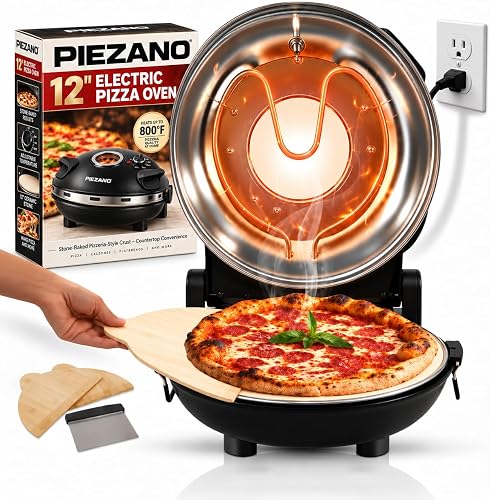
- Indoor countertop design
- 12 in ceramic stone
- Separate top and bottom heat controls
- 1200 W
This compact indoor oven suits fresh pizza without an outdoor setup. Separate heat controls let you adjust the base and toppings independently.
Pros
- Separate upper and lower heat controls
- Removable ceramic stone
- Two wooden peels included
Cons
- Limited to 12 in pizzas
- Manual heat adjustment takes practice
The Piezano 12 inch electric suits a kitchen where counter space is limited but fresh stone-baked pizza is the goal. Its roughly 14 in footprint is smaller than the enclosed indoor models farther down this list.
Its main advantage is separate upper and lower heat controls. If the cheese browns before the base firms up, you can change the balance rather than simply cooking everything longer at the same setting.
Piezano says it reaches 800°F and bakes fresh pizza in under 6 minutes. Start with the recommended settings, then change one control at a time so you can learn what improves your crust.
The removable ceramic stone, wooden peels and scraper provide the main tools for an initial pizza night. Leave room above the oven to open its lid safely.
Choose it for compact indoor cooking and direct heat adjustment. Skip it for larger pies, and read is a pizza oven worth it? if you're unsure a dedicated appliance will earn its space.
Big Horn 15 inch gas

- Propane fuel
- Fits pizzas up to 14.7 in
- Dual burners and control knobs
- Built-in thermometer
Choose this propane oven when larger shared pizzas matter more than easy carrying. Dual controls let you adjust the burners independently.
Pros
- More pizza space than 12 in models
- Built-in thermometer
- Foldable peel and regulator hose included
Cons
- Heavier to move between uses
- Needs outdoor oven and propane space
Big Horn 15 inch gas suits households that prefer cutting a larger shared pizza instead of making several small ones. The usable capacity is up to 14.7 in, so size your dough to that limit.
Its dual burners have independent control knobs, giving you a way to change heat on each side. A built-in thermometer helps you follow the chamber temperature, though it doesn't measure the stone surface.
Big Horn says the oven reaches 750°F in 10 minutes. Give the stone time to heat as well, especially before the first pizza or after a run of bakes.
At 35.3 lb, it makes more sense on a planned outdoor cooking station than as something you carry out casually. Allow room for the propane supply and safe hose routing.
Choose it when cooking area matters more than easy carrying. The foldable peel and regulator hose help complete the setup; for frequent trips, compare our portable pizza oven picks.
Presto Pizzazz Plus 03430

- Continuously rotating tray
- Separate top and bottom heating elements
- Timer with automatic heat shutoff
- Removable nonstick pan
A practical pan-based choice for frozen, take-and-bake and homemade pizza. Its rotating tray and heat shutoff timer suit straightforward weeknight cooking.
Pros
- No preheat required
- Separate top and bottom heat
- Removable nonstick pan
Cons
- Pan baking rather than stone baking
- Limited to 12 in pizzas
Presto Pizzazz Plus 03430 suits frozen pizza nights, take-and-bake meals and convenience foods. Its rotating pan offers a different approach from the enclosed stone ovens in this roundup.
You can select top heat, bottom heat or both. That helps when a pizza needs more cooking underneath without continuing to brown the cheese at the same rate.
The timer automatically switches off the heating elements when cooking time ends. You still need to watch the food, especially when learning a new pizza thickness or cooking something beyond pizza.
Presto says no preheat is needed, which makes this a practical choice for a quick cooking routine. The removable nonstick pan also avoids the stone-care steps required by several other picks.
Choose it if you want an appliance for pizza and snacks with simple heat selection. Skip it if your main goal is learning high-heat stone baking and making a puffed, char-spotted crust from fresh dough.
Solo Stove Pi Prime

- Propane fuel
- Cordierite pizza stone
- Front-facing temperature control
- Wide opening
The wide opening suits cooks who want a clear view and room for quick turns. A front-facing control keeps flame adjustments within easy reach.
Pros
- Wide opening for watching and turning
- Front-facing flame control
- Cordierite stone
Cons
- Requires attention during baking
- No timer function
Solo Stove Pi Prime suits outdoor cooks who want propane heat with a clear view of the bake. Its wide opening makes it easier to see the edge nearest the flame and get a peel underneath for turns.
The front-facing flame control is useful when switching from heating the stone to managing browning during a bake. You can adjust the flame without reaching around the oven.
A cordierite stone and 304 stainless steel body form the cooking setup. Solo Stove says it preheats in 15 minutes and cooks pizza in as little as 90 seconds.
Choose this model if watching, turning and adjusting the pizza is part of the fun. It has no timer, so finish your prep before launching and keep your attention on the oven.
Skip it if you want wood or charcoal cooking, or prefer enclosed electric controls. If solid fuel appeals more, our guide to the best wood for a pizza oven explains that route.
Big Horn 14 inch indoor

- 14 in pizza capacity
- Electric countertop oven
- Six cooking programs
- Flip-up design
This larger indoor model suits households that want shared pies without cooking outside. Its flip-up design helps with storage after the oven has cooled.
Pros
- Fits larger indoor pizzas
- Six cooking programs
- Stone and peel included
Cons
- Needs full working space during use
- 1800 W electrical load needs planning
The Big Horn 14 inch indoor suits families who want larger pies without moving pizza night outside. Its extra cooking area is the main reason to choose it over a smaller countertop model.
The oven has six programs, including frozen, New York, thin crispy and deep dish. Start with the mode that matches your dough and pan choice, then adjust for thickness and topping load.
Big Horn says it reaches 850°F, with a 15-minute preheat and a 3-minute pizza cook. Treat those as cooking estimates rather than reasons to rush a stone that isn't ready.
The flip-up design helps with storage, but it doesn't reduce the space needed while cooking. Measure the full 20.31 x 18.86 in footprint and leave the required clearance around it.
Choose it for larger indoor pies and storage flexibility; skip it if your working counter is too shallow. Our best countertop pizza ovens guide compares more kitchen options.
Chefman indoor pizza oven

- 12 in pizzas
- Five pizza presets plus manual mode
- Temperature range from 300 to 800°F
- Pizza stone and peel included
Chefman suits indoor cooks who want style presets before moving to manual settings. The included stone and peel cover the main pizza tools.
Pros
- Five presets plus manual mode
- Stone and peel included
- Double-paned viewing window
Cons
- Limited to 12 in pizzas
- Needs counter and door-opening space
Chefman indoor pizza oven suits cooks who want a clear starting point for several pizza styles. Its touchscreen presets cover Neapolitan, New York, thin crust, pan and frozen pizza, with manual control available as you learn.
The 300 to 800°F range gives you room to change your approach for different doughs. A thicker pizza needs a different heat balance and cooking time from a thin, lightly topped one.
Chefman says the double-paned window and high-heat design help retain heat between pizzas. Still, let the stone recover when later pizzas start coming out pale underneath.
The included stone and peel cover the main tools, but allow counter space for loading the peel and opening the door. Its body measures 18.7 x 17 in before adding operating clearances.
Choose Chefman for guided indoor baking; choose Piezano if smaller size and separate heat knobs matter more. Our Chefman indoor pizza oven review gives a closer look at its controls.
Gozney Arc Lite

- Propane outdoor oven
- 12 in pizzas
- Lateral flame
- Removable stone floor
Arc Lite suits cooks who want a compact propane oven for a run of backyard pizzas. Its insulated body and removable stone floor support that focused setup.
Pros
- Lateral rolling flame
- Dense two-layer insulation
- Removable stone floor
Cons
- Peels are separate accessories
- No timer function
- Outdoor use only
Gozney Arc Lite suits backyard cooks who plan to make several pizzas and want propane flame control in a compact oven. Its lateral rolling flame provides the live-fire cooking approach without tending wood.
The removable stone floor and two-layer insulation are central features. Gozney says they help retain heat across repeated bakes, making this a useful choice for serving pizzas in a steady sequence.
The oven reaches up to 950°F, and Gozney gives a 60-second cooking estimate for a pizza. Watch the crust closely and turn as needed rather than relying on a timer.
Plan for placement and turning peels as separate accessories. A compact oven still needs a stable outdoor surface and clear space to work in front of its opening.
Choose Arc Lite for focused propane pizza cooking; skip it if you need larger pies or indoor use. See our Gozney Arc, Roccbox and Tread comparison for more brand options.
How should you choose a pizza oven for home?
Choose by location, cooking routine and pizza size, in that order. Peak temperature and fast cooking claims matter less than having an oven you can set up and use comfortably.
What makes the best home pizza oven fit your space?
The best fit has enough room for safe operation, food preparation and storage. The oven's body dimensions are only part of that space.
Account for an opening door or lid, overhead clearance and room to move a long peel. For an outdoor setup, include the propane cylinder or fuel container in your plan.
Keep outdoor fuel-burning ovens outside, and don't assume an electric model belongs indoors. Read can you use a pizza oven indoors? before deciding where to cook.
Which fuel fits your weeknight routine?
Electric suits controlled cooking, propane suits adjustable outdoor flame, and solid fuel suits cooks who enjoy tending a fire. Choose the process you'd be happy repeating after a busy day.
With pellets, wood or charcoal, you manage both the oven and its fuel supply. Propane removes the solid-fuel feeding task but still requires flame control and a safe cylinder setup.
Multi-fuel flexibility is useful only if you expect to switch. Our gas or wood-fired pizza oven comparison helps you decide before paying for extra burners.
How much pizza space will you use?
Choose enough space for your normal dough size, with room to launch and turn it. A pizza that fits tightly leaves less margin when it stretches unevenly or lands off-center.
For guests, think about serving rhythm as well as diameter. Several smaller pizzas allow different toppings, while larger pies reduce the number of launches.
Most compact home ovens cook one pizza at a time. Cut and share each pie as it comes out instead of expecting the whole group to receive a separate pizza at once.
Which controls and accessories are worth choosing?
Choose controls that solve your main cooking concern. Separate upper and lower heat adjustment helps balance base and topping color, while presets provide a starting point for a pizza style.
A chamber thermometer and an infrared stone thermometer answer different questions. The first tracks oven air temperature; the second helps you judge the surface that cooks the crust.
Check for a suitable peel, stone or pan before planning your first cook. Our pizza oven guide for beginners explains how fuel, size and heat work together.
How do you set up a home pizza oven?
Set the oven on a stable, heat-safe surface and complete the manufacturer's setup steps before adding food. A convenient working height helps you launch pizza without leaning over a hot opening.
Keep a clear landing space for cooked pizza, separate from raw dough preparation. Place tools within reach so you don't leave a fast bake to search for a peel or tray.
For gas, follow the connection and leak-check instructions before ignition. For electric ovens, follow circuit requirements and cord guidance, especially around other high-power kitchen appliances.
A suitable surface needs to support the oven while leaving space for safe movement. Our guide to choosing a pizza oven stand or table covers that part of the setup.
Read the first-use directions, including any required heat cycle. Have dough and toppings ready before preheating ends, but assemble each pizza close to launch time.
How do you avoid burnt toppings and a pale crust?
Start with a fully heated stone, evenly stretched dough and restrained toppings. A hot chamber can brown cheese before an underheated cooking surface finishes the base.
Don't confuse the advertised cooking time with the full meal time. Preheating, dough preparation and heat recovery between pizzas all affect when you'll eat.
Make the first launches smaller
Start below the oven's maximum pizza size and keep the dough center even. Thick patches stay soft longer, while very thin spots can tear during launch.
Dust the peel lightly and check that the pizza slides before approaching the oven. A wet, heavily topped pizza left on a peel too long is more likely to stick.
Match heat to the pizza style
Use the recipe and oven directions for thicker crusts or pan pizza. Maximum heat is useful for some thin styles, but it can scorch a thick pizza before the center cooks.
Drain wet ingredients and avoid piling toppings in the middle. Add delicate finishing ingredients after baking when the recipe calls for it.
Watch the bake and allow recovery
Turn pizza when your oven requires it, checking the side nearest the flame. For models designed to cook without turning, still watch for doneness through the available window or opening.
Let the stone regain heat between pizzas if bases become pale. Our guide to using a pizza oven walks through preparation, launch and cooking.
How should you clean and store a pizza oven?
Let the oven and stone cool completely before cleaning, moving or covering them. Never pour cold water onto a hot stone, since the sudden temperature change can crack it.
Remove loose flour and food debris with tools approved for the cooking surface. Follow the stone's care instructions, and avoid soaking it or adding detergent unless the manufacturer allows it.
Clean removable nonstick pans with suitable nonabrasive tools. Keep water away from electric controls and heating components, and follow fuel-specific directions for removing ash.
Store solid fuel dry, and empty waste only after it is fully cold. Put the oven away only when its surfaces are dry and it has cooled enough for safe handling.
Which best pizza oven for home should you choose?
Choose the Big Horn 12 inch multi-fuel if changing outdoor fuels is part of your plan, or Ooni Karu 2 if wood and charcoal cooking are the main attraction. Choose a dedicated propane model when you want flame control without feeding solid fuel.
For indoor cooking, pick Piezano for a smaller counter, Chefman for guided settings, or Big Horn 14 inch indoor for larger shared pies. Presto suits pan-based convenience meals, while Ninja suits outdoor electric cooking.
The best pizza oven for home is the one whose setup you'll repeat often. Measure its working space, choose your fuel, then use our gas, wood and electric pizza oven comparison to settle the final choice.
Our top 3 picks at a glance
-
1
-
2
-
3
Frequently asked questions
What is the best pizza oven for home use?
The Big Horn 12 inch multi-fuel is our top outdoor pick for fuel flexibility, with optional burners sold separately. Choose Piezano for a compact indoor stone oven, Ninja Artisan MO201 for outdoor electric cooking, or a larger Big Horn model when shared family pies are your priority.
Can a pizza oven be used indoors?
Only use a pizza oven indoors when its instructions allow it. Electric power does not guarantee indoor suitability, and outdoor fuel-burning ovens must stay outside.
Allow all required clearances around the appliance, including above it, and read our guide to using a pizza oven indoors before choosing its location.
Should I choose gas, wood or electric?
Choose indoor-rated electric for kitchen cooking, propane for outdoor flame control, or wood if you enjoy tending a fire. Outdoor electric is another option when you have a suitable power supply.
Our gas vs wood-fired pizza oven guide explains the differences in fuel handling and cooking routine.
What size pizza oven should I get?
Choose a 12 in oven for individual or smaller shared pizzas, and a larger model when you prefer fewer, bigger pies. Leave room to launch and turn dough rather than filling every available inch.
Measure the oven's working space, door movement and required clearances as well as its cooking surface.
Are pizza ovens hard to use?
Electric presets and propane controls simplify heat management, while wood and pellets add fuel tending. Every style still benefits from well-prepared dough, restrained toppings and enough preheat time.
Start with smaller pizzas and read our guide to using an outdoor pizza oven for the basic cooking sequence.