Can You Use a Pizza Oven Indoors?
Yes, you can use a pizza oven indoors if it is designed for indoor use and your kitchen meets its clearance, ventilation, and power requirements. Outdoor gas, wood, and charcoal ovens belong outside, even if you open windows or run a range hood.
On this page (8 sections)
- Can you use a pizza oven indoors safely?
- Why shouldn't outdoor pizza ovens be used inside?
- What should you check before buying an indoor oven?
- Which indoor pizza oven suits your cooking habits?
- How should you set up and cook your first pizza?
- How can you reduce smoke and care for the oven?
- Are indoor pizza ovens worth the counter space?
- Can you use a pizza oven indoors? Make the final choice
Yes, you can use a pizza oven indoors if it is designed for indoor use and your kitchen meets its placement and power requirements. A countertop electric model is the practical choice, but electric power alone doesn't make every oven suitable.
Outdoor ovens that burn gas, wood, or charcoal belong outside. A kitchen, garage, or enclosed porch doesn't become a safe cooking location just because you open a window.
The right indoor oven depends on your available counter space, preferred pizza size, and how much control you want over the bake.
Can you use a pizza oven indoors safely?
You can use an indoor-rated electric pizza oven safely by following its manual for clearances, ventilation, and electrical supply. Confirm the intended location before buying, rather than judging by the oven's size or fuel alone.
Indoor electric ovens avoid burning fuel in the room, but they still produce heat and cooking fumes. Keep children and pets away from the cooking area, and leave the required space above and beside the appliance.
Start with our guide to pizza ovens for home use if you're choosing between indoor convenience and an outdoor cooking setup.
Why shouldn't outdoor pizza ovens be used inside?
Outdoor fuel-burning pizza ovens can produce carbon monoxide and dangerous heat, so keep them outside. A range hood or open window doesn't turn an outdoor appliance into an indoor one.
Use an outdoor oven only in the location and clearances its manufacturer allows. Don't assume a roofed patio or partly enclosed area meets those rules.
For an outdoor setup, read how to use an outdoor pizza oven. Our comparison of gas and wood-fired pizza ovens explains the fuel choice.
What should you check before buying an indoor oven?
Check usable space, electrical supply, and cooking size before comparing presets or maximum heat. An oven that fits your pizza still needs room for airflow, loading, and removing hot food.
Measure the counter's depth and width, then add the manual's required clearances. Check door or lid movement too, especially near a backsplash, wall outlet, or overhead cabinet.
Leave a clear place beside the oven for a peel and a heat-safe landing area for cooked pizza. A crowded counter makes loading harder and puts loose packaging or towels closer to hot surfaces.
Think about portions as well as diameter. A smaller oven can serve several people through separate bakes, but everyone may eat at different times.
What power do you need to use a pizza oven indoors?
You need an outlet and circuit that meet the exact model's electrical requirements. The Chefman uses 1700 watts at 120 volts, while the Piezano uses 1200 watts at 120 volts.
The Big Horn uses 1800 watts and requires a 110–120-volt supply; the Presto uses 1235 watts at 120 volts. Check which other appliances share the circuit before running a kettle, toaster, or similar appliance alongside the oven.
Follow the manual's rules on extension cords and power strips. If a breaker trips or the outlet becomes hot, stop using the oven and have the cause checked before cooking again.
Which indoor pizza oven suits your cooking habits?
Choose presets for guided cooking, separate heat controls for adjustment, or a rotating pan for everyday convenience foods. These 4 options serve different kitchens and pizza routines.
Chefman: for cooks who want presets and manual control
The Chefman suits you if you want guided settings with room to adjust recipes. Its 5 touchscreen presets cover Neapolitan, New York, thin-crust, pan, and frozen pizza, with a manual setting for other choices.
Its temperature range is 300–800°F, and the body measures 18.7 inches deep, 17 inches wide, and 10.94 inches high. Measure that full depth before choosing a permanent spot.
Pick it if you alternate between fresh dough and frozen pizza and prefer named modes over starting each bake from scratch. Skip it if your counter can't accommodate its body plus the required clearance.
Use a preset as a starting point, then watch the crust and toppings. Dough thickness and topping moisture can change when a pizza is ready; the Chefman pizza oven review gives more detail on this option.
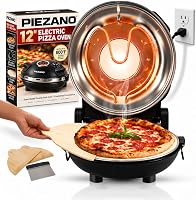
Piezano: for smaller counters and separate heat adjustment
The Piezano suits kitchens where counter footprint matters and cooks who want direct control over browning. Its separate knobs let you change upper and lower heat independently.
It measures 13.62 inches deep, 13.77 inches wide, and 6.49 inches high, and reaches 800°F. Allow space for the lid to open as well as the required heat clearance.
Choose it if you want to adjust a pale base without adding as much heat above the toppings. Skip it if larger pizzas are a priority or you prefer named cooking presets.
Its removable ceramic stone helps with access for cleaning after cooling. For a closer choice between controls and presets, see Piezano vs Chefman.
Big Horn: for households that want larger pizzas
The Big Horn suits households that want a larger pizza in each bake. Its temperature range of 220–850°F and 6 programs also provide options beyond a single high-heat setting.
The body measures 20.31 inches deep, 18.86 inches wide, and 10.44 inches high. Its flip-up design helps with storage, but you still need the full operating space while cooking.
Choose it if sharing a larger pie matters more than minimizing the working footprint. Skip it if your available counter is shallow or the electrical requirements don't suit your kitchen.
The Wood Fired program is a cooking mode, not a wood-burning fuel system. This remains an electric appliance, so choose it for indoor cooking rather than expecting a live-fire setup.
Presto: for frozen pizza and convenience foods
The Presto suits you if your main goal is straightforward pizza and snack cooking rather than a high-heat stone bake. It handles frozen, homemade, take-and-bake, and deli pizza, plus foods such as nuggets and cinnamon rolls.
Its removable nonstick pan holds pizzas from 7–12 inches. The timer signals when cooking ends and automatically switches off the heating elements.
Choose it if a removable pan and simple element selection fit your routine. Skip it if you're specifically shopping for an enclosed stone oven with an 800°F temperature setting.
Use the lower element to give the base more cooking time or the upper element to finish toppings, following the recipe instructions. Keep the area around the rotating pan clear while it operates.
How should you set up and cook your first pizza?
Set up the oven according to its manual, then start with a manageable pizza and light toppings. A smaller first pizza is easier to transfer and leaves more room to correct its position.
- Remove packaging and complete any first-use steps in the manual.
- Position the oven with the required clearances and a safely routed cord.
- Fit the stone or pan correctly before heating.
- Preheat when instructed, using the guidance for that model and recipe.
- Prepare mitts, a suitable peel, and a landing surface before loading.
For fresh dough, check that the pizza can slide from the peel before approaching the hot oven. Use enough flour to prevent sticking, but brush away loose excess that could burn.
Drain wet toppings and avoid piling ingredients in the center. A heavily loaded pizza can have browned cheese while the dough beneath remains undercooked.
Don't assume the highest temperature suits every recipe. Thick crusts and dense toppings may need a gentler bake than a thin pizza.
How can you reduce smoke and care for the oven?
Reduce smoke by limiting loose flour, avoiding spills, and removing cooled food residue. An electric oven can still smoke when cheese, oil, or toppings reach very hot surfaces.
Run kitchen ventilation as directed, and keep air openings clear. If smoke persists after normal cleaning and correct setup, stop and follow the troubleshooting instructions.
Let the oven cool before cleaning or moving it, and unplug it as directed. Don't pour water onto a hot stone, immerse the electrical body, or spray cleaner into heating elements.
Clean each cooking surface according to its material and manual. A nonstick pan needs tools that won't scratch it, while a pizza stone may have restrictions on soap and soaking.
Let a cleaned stone dry fully before reheating it. Never move or fold an oven for storage while it's still hot.
Are indoor pizza ovens worth the counter space?
An indoor oven makes sense if you'll use its cooking style often enough to justify a dedicated space. High-heat stone models suit fresh pizza routines, while a rotating pan may better match frozen pizza and snacks.
Compare the whole routine, including preheating, preparing dough, serving separate pizzas, and cooling before cleanup. A short bake time doesn't describe the full time needed for dinner.
Read are indoor pizza ovens any good for more on the tradeoffs. Compare indoor pizza ovens and countertop pizza ovens once you know your space and cooking needs.
Can you use a pizza oven indoors? Make the final choice
You can use a pizza oven indoors when the model is intended for indoor use and your kitchen meets its requirements. Rule out ovens that fail the placement or power check before choosing features.
Pick Chefman for presets, Piezano for a smaller footprint and separate heat knobs, Big Horn for larger pizzas, or Presto for a rotating pan and convenience foods.
If you're still deciding whether you'll use a dedicated appliance often enough, read is a pizza oven worth it before making space for one.
Frequently asked questions
Can I use an outdoor pizza oven inside?
No, keep outdoor gas, wood, and charcoal pizza ovens outside because they can produce carbon monoxide and intense heat; opening windows or running a range hood doesn't make them suitable for indoor use. Choose an indoor electric model and follow its instructions for placement and operation.
Do indoor electric pizza ovens need ventilation?
Yes, indoor electric pizza ovens need the airflow and ventilation specified in their manuals; flour, cheese, and toppings can burn and create cooking smoke even without a flame. Use kitchen ventilation as directed, keep required clearances open, and clean food residue once the oven has cooled.
Can I plug an indoor pizza oven into a regular outlet?
Some models use standard household outlets, but voltage alone doesn't confirm that your circuit can handle the load; check the oven's wattage and circuit requirements, including rules about shared appliances and extension cords. Ask a qualified electrician if you're unsure whether your outlet and circuit are suitable.
Is a countertop pizza oven safe on any kitchen counter?
No, the counter must be stable, heat-resistant, and suitable under the oven's placement instructions; measure space for the appliance, its required clearances, and the open door or lid. Keep cords, paper, curtains, and other items away from hot surfaces, and check restrictions on overhead cabinets.