7 Best Countertop Pizza Ovens (October 2026)
The best countertop pizza ovens include the Ninja Artisan MO201 for backyard meal prep, the Piezano 12 inch electric for small kitchens, and the Presto Pizzazz Plus 03430 for frozen pizza nights.
On this page (6 sections)
- Which is the best countertop pizza oven for your routine?
- How should you choose a countertop pizza oven?
- How do you set up and cook your first pizza?
- Which mistakes cause disappointing countertop pizza?
- How do you clean and store a countertop pizza oven?
- Which best countertop pizza oven pick should you buy?
The Piezano 12 inch electric is the best countertop pizza oven here for compact indoor pizza nights, thanks to its removable ceramic stone and separate top and bottom heat controls. The higher-scoring Ninja Artisan MO201 is the outdoor choice for cooking whole meals alongside pizza.
Choose by location first, then by the pizza you make most often. A frozen-pizza routine calls for different features than stretching fresh dough or serving several homemade pies in a row.
For more kitchen options, see the best indoor pizza ovens. Our guide to the best electric pizza ovens covers the wider electric category.
Our picks at a glance
-
1

-
2
-
3

Which is the best countertop pizza oven for your routine?
The Piezano is the strongest indoor starting point, while Presto suits frozen-pizza meals and Big Horn offers room for larger pies. Ninja leads the scores for its outdoor versatility, so its position doesn't make it the right kitchen appliance.
ChipperChimney compared cooking surfaces, controls, capacity and intended location. Use the table to narrow the choice, then read the tradeoffs for the models that match your routine.
| Product | Best for | Pizza size | Temperature range | Functions | Our score |
|---|---|---|---|---|---|
| Ninja Artisan MO201 | backyard meal prep | 12 in | 90 to 700 F | Pizza, bake, broil, proof and warm | 8.7 |
| Piezano 12 inch electric | small kitchens | 12 in | 8.5 | ||
| Presto Pizzazz Plus 03430 | frozen pizza nights | 7 to 12 in | 8.3 | ||
| Big Horn 14 inch indoor | larger family pies | 14 in | 220 to 850 F | 8.1 | |
| Chefman indoor pizza oven | preset-led cooking | 12 in | 300 to 800 F | 8.0 | |
| Piezano XL 14 inch electric | larger homemade pizzas | 14 in | 7.8 | ||
| NutriChef 1200W pizza oven | watching crust brown | 12 in | 716 to 800 F | 6.8 |
Ninja Artisan MO201: an outdoor countertop pizza oven for full meals
Choose the Ninja Artisan MO201 for backyard meal prep when pizza is only part of what you want to cook. Skip it if your purchase needs to work on a kitchen counter.
Ninja Artisan MO201
- 12-inch pizza capacity
- Five pizza settings
- Bake, broil, proof and warm functions
- Temperature range from 90 to 700 F
Choose this outdoor electric oven if pizza shares the menu with bread and baked sides. Its extra cooking functions suit a backyard cooking station.
Pros
- Five pizza settings
- Dedicated dough proofing function
- Pizza stone and bake pan included
Cons
- Requires an outdoor cooking location
- Ninja's 3-minute pizza claim excludes an 18-minute preheat
Its 5 cooking functions are pizza, bake, broil, proof and warm, with pizza settings for Neapolitan, thin crust, pan, New York and custom styles. The included stone and bake pan let you switch between pizza night and baked sides.
The temperature range runs from 90 to 700 F, including a low proofing setting for dough. That makes it a useful match for someone who enjoys preparing dough as well as baking it.
Ninja says a 12-inch pizza cooks in 3 minutes at maximum heat without turning, excluding an 18-minute preheat. Plan around the whole session rather than assuming dinner starts 3 minutes after switching it on.
The window lets you watch food while keeping the door closed. Its capacity also covers a large sourdough loaf or 6 chicken breasts, giving it a role beside a grill.
This is a better fit for a regular outdoor cooking station than a buyer who simply wants indoor pizza. Ninja recommends a cover for outdoor storage, even though the oven is weather resistant.
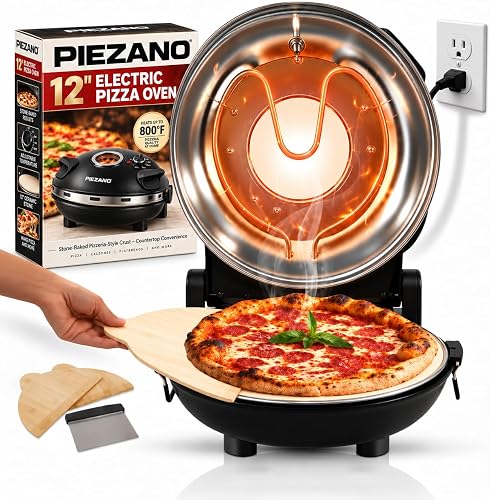
Piezano 12 inch electric: a compact indoor choice with direct controls
Choose the Piezano 12 inch electric for smaller homemade pizzas when you want to adjust crust and topping heat yourself. Skip it if your usual pizzas need a wider cooking surface.
Piezano 12 inch electric
- 12-inch ceramic stone
- Heat up to 800 F
- Separate upper and lower heat controls
- Viewing window and thermometer
A compact stone oven for cooks who want direct control over crust and topping browning. Choose it when smaller homemade pizzas fit your meal plan.
Pros
- Removable ceramic stone
- Independent upper and lower controls
- Two wooden peels and dough scraper included
Cons
- Limited to 12-inch pizzas
- Manual heat adjustments require attention during cooking
The removable ceramic stone gives fresh dough a hot baking surface, while separate upper and lower knobs let you change the balance of heat. That control matters when cheese browns before the base is ready, or the base finishes first.
It reaches 800 F, and Piezano says a fresh pizza cooks in under 6 minutes. Treat that as a cooking-time claim, with preheating and dough preparation still part of the meal.
The body measures about 13.6 inches deep by 13.8 inches wide, but your working area also needs room to open the lid and handle a peel. Its window and thermometer help you watch progress without repeatedly opening it.
Two wooden peels and a dough scraper are included. Keep the peel lightly dusted and avoid letting a topped pizza sit on it long enough to stick.
This suits a cook who wants to learn heat balance through small changes. Our Piezano vs Chefman comparison helps you choose between that approach and touchscreen presets.
Presto Pizzazz Plus 03430: a practical choice for frozen pizza
Choose the Presto Pizzazz Plus for frozen and take-and-bake meals when you prefer a removable pan to launching dough onto stone. Skip it if direct stone baking is the reason you're buying an oven.
Presto Pizzazz Plus 03430
- Continuously rotating tray
- Separate top and bottom heating elements
- Timer that shuts off heating elements
- Removable nonstick pan
Choose this rotating-pan design for frozen pizza, take-and-bake meals and convenience foods. It starts cooking without a separate preheat.
Pros
- No separate preheat required
- Top and bottom heat can be selected separately
- Timer automatically turns off heating elements
Cons
- Uses a nonstick pan instead of a pizza stone
- Limited to pizzas up to 12 inches
The tray rotates continuously under the heating unit, and you can select top heat, bottom heat or both. It handles pizzas from 7 to 12 inches and starts cooking without a separate preheat.
That makes it a clear match for a weeknight routine built around prepared food. Presto also includes convenience foods such as chicken nuggets, egg rolls and fish fillets among its uses.
The timer signals the end of cooking and shuts off the heating elements. Stay nearby so you can judge browning and remove the food when it's ready.
Separate heat selection gives you a useful correction tool. If the top is done but the crust needs longer, bottom-only heat lets you continue without applying more upper heat.
The removable nonstick pan also changes the cleanup routine: you're cleaning a pan rather than caring for a porous stone. Use utensils and cleaning tools suitable for its coating, and let the pan cool before washing.
Big Horn 14 inch indoor: more room for shared pizzas
Choose the Big Horn 14 inch indoor for wider family pies and a preset menu. Skip it if your counter can only spare a small working area.
Big Horn 14 inch indoor

- 14-inch pizza capacity
- Maximum temperature of 850 F
- Six preset programs
- Flip-up storage design
A larger stone and preset menu suit households that want wider pizzas indoors. The flip-up design helps with storage after the oven has cooled.
Pros
- 14-inch stone
- Six preset programs
- Pizza stone and peel included
Cons
- Needs substantial counter space while cooking
- Big Horn says preheating takes 15 minutes
The 14-inch stone gives you more room to stretch a shared pizza, while the temperature range runs from 220 to 850 F. Six programs cover manual, wood fired, frozen, New York, thin crispy and deep dish.
The Wood Fired program is a setting on an electric oven; it doesn't mean you add wood. Use the program that suits your dough and crust thickness, then adjust future cooks based on browning.
Big Horn says preheating takes 15 minutes and pizza can cook in 3 minutes. Give the stone its full warm-up rather than loading as soon as the oven begins to feel hot.
Its body measures about 20.3 inches deep by 18.9 inches wide before allowing for clearance and food handling. The flip-up design helps with storage, but it doesn't reduce the space needed while cooking.
A peel and removable stone are included. Choose this over the smaller indoor models when the wider pie is useful every week, rather than buying extra capacity you rarely fill.
Chefman indoor pizza oven: presets for a repeatable starting point
Choose the Chefman indoor pizza oven if you prefer named pizza presets to setting every control from scratch. Skip it if you want a lighter appliance to carry out of a cupboard for each meal.
Chefman indoor pizza oven

- 12-inch pizza capacity
- Heat up to 800 F
- Five pizza presets and manual mode
- Pizza stone and peel included
Choose Chefman if you want named pizza presets as a starting point, with manual settings for later adjustments. It suits a regular spot on the counter.
Pros
- Five pizza presets plus manual mode
- Double-paned viewing window
- Pizza stone and peel included
Cons
- Limited to 12-inch pizzas
- Weighs 23.3 pounds
Its touchscreen offers Neapolitan, New York, thin-crust, pan and frozen settings, plus manual mode. Presets provide a starting point, but dough thickness and topping moisture still affect when a pizza is ready.
The upper and lower elements operate across a 300 to 800 F range. Chefman says its high-heat design retains heat for back-to-back cooking, which makes it worth considering for a household serving several individual pies.
A double-paned window lets you watch the bake without opening the door. Wait for the oven's ready indication between pizzas rather than assuming the next base will cook exactly like the first.
The included stone and peel cover the main baking and transfer tools. At 23.3 pounds, this oven makes more sense in a regular counter spot than as something you move while preparing dinner.
Choose Chefman for a routine built around a few favorite pizza styles. Read our Piezano vs Chefman comparison if you're deciding how much manual control you want.
Piezano XL 14 inch electric: wider pies with adjustable heat
Choose the Piezano XL for larger homemade pizzas when you want adjustable upper and lower heat. Skip it if smaller pies already meet your needs or you prefer a menu of pizza presets.
Piezano XL 14 inch electric

- 14-inch ceramic stone
- Heat up to 800 F
- Adjustable top and bottom heat
- Built-in thermometer
The wider ceramic stone suits cooks who want larger homemade pies and adjustable upper and lower heat. Choose it for pizza capacity rather than a preset menu.
Pros
- 14-inch removable ceramic stone
- Adjustable upper and lower heat
- Built-in thermometer
Cons
- Wider pizzas take more care to transfer
- Larger stone to handle during cleaning
Its 14-inch ceramic stone offers more stretching room than the standard Piezano. The wider surface is useful for shared pies, but you don't need to fill it on your first cook.
It reaches 800 F and includes a built-in thermometer. Start with a manageable dough size so you can learn to transfer the pizza without folding an edge or spilling toppings.
The removable stone helps with access for cleaning, and the package includes a peel. Allow a clear route from your preparation area to the oven, especially when carrying a wider, softer base.
Suction cups help hold the oven in place, and its plug requires a grounded 3-prong outlet. Confirm the exact model's outside measurements and lid-opening space before ordering, since cooking diameter doesn't guarantee counter fit.
Choose the XL because you regularly want a larger pie. Extra stone area adds little value if your main meals are small personal pizzas.
NutriChef 1200W pizza oven: visible cooking with separate heat dials
Choose the NutriChef for watching and adjusting a pizza as it browns, with a window, thermometer and independent heat controls. Skip it if you want one appliance for low-temperature baking or dough proofing.
NutriChef 1200W pizza oven

- 1200 W power
- Independent upper and lower controls
- Viewing window and thermometer
- Nonstick pizza plate
A window, thermometer and separate heat controls suit cooks who want to watch and adjust the bake. Its high-temperature range makes it a pizza-focused choice.
Pros
- Viewing window and thermometer
- Independent upper and lower controls
- Wooden paddles, cutter and spatula included
Cons
- Temperature range starts at 716 F
- Limited to 12-inch pizzas
The oven fits a 12-inch pie on a nonstick pizza plate and uses 1200 W. Its stated temperature range is 716 to 800 F, so its role is high-temperature cooking rather than gentle warming.
Separate top and bottom controls let you respond to uneven progress between the base and toppings. Make one adjustment at a time so you can tell which change helped.
The window is useful for spotting darkening crust before opening the lid. A thermometer reading tracks oven temperature, but you still need to check the food itself for doneness.
NutriChef includes wooden paddles, a cutter and a spatula. Use a separate board for slicing so you don't cut into the cooking surface or damage its coating.
This is a narrower recommendation than the higher-scoring indoor picks. Choose it for its window-and-dial layout and nonstick plate; choose Piezano if a removable ceramic stone is central to your plans.
How should you choose a countertop pizza oven?
Choose by cooking location, pizza style and usable space, in that order. Maximum temperature is useful only after the oven fits your home and the meals you want.
Start with an approved cooking location
An electric power cord doesn't make every oven suitable for indoor use. The outdoor Ninja needs an outdoor setup; kitchen buyers should stay with models intended for indoor cooking.
Read our guide to whether you can use a pizza oven indoors before choosing a location. The exact model's instructions determine placement, ventilation and clearances.
For a broader comparison of cooking locations and fuels, start with our guide to pizza ovens for home. It can help if you're still deciding between a kitchen appliance and an outdoor cooking station.
Match the surface to your usual pizza
A stone suits fresh dough baked directly on a hot surface. A pan-based design suits buyers who prefer placing prepared food on a tray instead of transferring a soft pizza with a peel.
Think about thickness as well as diameter. Thin dough can bake quickly at high heat, while thick crust needs enough time for the center to cook before the top becomes too dark.
If most of your meals are frozen pizzas, make sure their diameter fits and follow the oven's guidance for frozen food. The hottest setting isn't automatically the correct one for packaged pizza.
Which countertop pizza oven controls suit you?
Choose independent heat controls if you want to adjust base crispness and topping browning separately. Choose presets if you'd rather begin with a setting named for your pizza style.
Manual controls reward attention and small changes. Presets reduce the number of choices at the start, but neither approach removes the need to watch a fast bake.
For a beginner, the better system is the one you'll use consistently. Keeping a short note of dough weight, setting and result can be more helpful than changing everything on each cook.
Measure working space, not just storage space
An oven needs room for safe operation, an opening lid or door, and the tools carrying hot food. Measure with nearby cabinets, outlets and your preparation area in mind.
A wider pizza also needs a wider clear landing spot. Check that you can move it onto a cutting board without passing over clutter or crossing another cooking task.
Fold-up storage helps only after the appliance has cooled. If every pizza night requires moving several other appliances, consider whether you'll use a dedicated oven often enough to justify the space.
Plan for the whole meal
Preheating, stretching dough, baking several pies and cooling the appliance all belong in your schedule. A short cooking time doesn't mean the whole household eats immediately.
Serving slices as each pizza finishes works well for a shared meal. If everyone needs a separate pizza at once, compare that routine with baking a larger batch in your regular oven.
Our pizza oven vs regular oven guide helps you decide whether the dedicated appliance fits how you serve dinner.
How do you set up and cook your first pizza?
Start with one modestly topped pizza after following the oven's first-use instructions. A simple first cook makes it easier to judge the dough, heat and timing.
Prepare the counter and electrical connection
Place the oven on the stable, heat-safe surface required by its manual. Keep the specified clearances open and route the cord away from hot surfaces, water and places where it could be pulled.
Check the electrical requirements before plugging in. Avoid sharing a circuit with other high-draw appliances during use, and follow the manual's rules for outlets and extension cords.
Set out a peel or suitable transfer tool, heat-resistant gloves and a cutting board before heating. You shouldn't need to search a drawer while holding hot food.
Get the dough ready before topping
Let dough relax enough to stretch without springing back, following your recipe's guidance. Shape the base evenly so a thick center doesn't lag behind a thin edge.
Prepare toppings before putting dough on the peel. Drain wet ingredients well and use a light layer of sauce, since excess moisture can leave the center soft.
If the oven supports direct stone baking, use a light dusting of suitable flour on the peel. Too much loose flour can scorch and leave a bitter taste.
Preheat fully and watch the bake
Follow the oven's full preheat instructions so the cooking surface has time to absorb heat. Hot air alone doesn't mean the stone is ready to bake the base.
Before transferring fresh dough, give the peel a gentle shake to check that the pizza moves freely. If it sticks, lift the edge and correct the problem before approaching the hot oven.
Watch through the window where available and use the controls to balance browning. Check both the underside and top before deciding the pizza is finished.
For several pies, follow the oven's guidance on recovering heat between cooks. Prepare the next dough round while waiting, but add toppings close to the transfer so the base doesn't become wet.
Which mistakes cause disappointing countertop pizza?
The most common problems come from too much moisture, incomplete preheating or a pizza that sticks during transfer. Fix the cause before making large changes to temperature.
- A browned top with a pale base: Allow the cooking surface to preheat fully, use less wet topping and adjust lower heat where the controls allow.
- A dark base with unfinished toppings: Use a more even dough thickness, reduce the topping load and adjust the heat balance rather than simply extending the same cook.
- Dough sticking to the peel: Work promptly after topping and check that it slides before moving toward the oven.
- A burnt flour taste: Use only enough dusting flour for release and clear loose residue according to the oven's cleaning instructions.
- A raw center in a thick pizza: Use settings and cookware suited to that style; maximum heat can brown the outside before the middle cooks.
Change one thing on the next pizza so you can identify the improvement. Starting with a simpler pie is often more useful than adding more toppings to hide an uneven bake.
How do you clean and store a countertop pizza oven?
Clean the oven after it has cooled fully, using the method specified for its cooking surface. Stone and nonstick pans need different care.
For a ceramic stone, remove loose crumbs and scrape away stuck food only with approved tools. Avoid soaking it or adding soap unless the manufacturer specifically allows that method.
Never pour cold water onto a hot stone or move it straight from high heat into water. Sudden temperature changes can damage ceramic.
For a nonstick pan or plate, use a soft tool and an approved cleaner. Keep knives, metal scrapers and rough pads away from the coating.
Wipe the exterior without letting water enter the controls or heating areas. Let removable parts dry fully before replacing them, and never fold or store a warm appliance.
Keep pizza tools nearby so setup stays simple next time. For an outdoor oven, follow the storage instructions and fit any cover only after the unit has cooled.
Which best countertop pizza oven pick should you buy?
Buy the Piezano 12 inch electric if you make smaller fresh pizzas indoors and want direct heat control. Choose Chefman for preset-led cooking or Presto when frozen and take-and-bake meals drive the purchase.
For wider pies, choose Big Horn if you want a preset menu and flip-up storage, or Piezano XL if adjustable top and bottom heat is your priority. Choose Ninja only when you have an outdoor cooking location and will use its functions beyond pizza.
The best countertop pizza oven is the one that fits your working space and gets used for your usual meals. If you're still weighing the extra appliance against your current routine, read whether indoor pizza ovens are good.
Our top 3 picks at a glance
-
1
-
2
-
3
Frequently asked questions
What is the best countertop pizza oven for most people?
The Piezano 12 inch electric is our indoor choice for smaller homemade pizzas, with a removable ceramic stone and separate heat controls. Choose Chefman if you prefer pizza presets, or Big Horn for wider pies.
The higher-scoring Ninja Artisan MO201 belongs outdoors and suits cooking beyond pizza.
Can a countertop pizza oven be used indoors?
Yes, if the exact model is designed for indoor use. The Ninja Artisan MO201 is an outdoor oven, despite using electricity.
Follow your oven's instructions for clearances, surface placement and electrical use. Read our guide to using a pizza oven indoors before deciding where it will stand.
Is a pizza stone necessary in a countertop pizza oven?
No, a pan-based oven can cook pizza without a stone. The Presto Pizzazz Plus uses a rotating nonstick pan with separately controlled heating elements.
Choose stone for baking dough directly on a hot surface, or a pan design if frozen pizza and convenience foods are your main meals.
What size countertop pizza oven should I choose?
Choose capacity around the pizzas you actually make. A 12-inch model suits smaller pies, while a 14-inch model gives you room for a wider pizza.
Measure the appliance's working footprint, required clearances and storage space too, since pizza diameter alone doesn't tell you whether an oven fits.